


AI’s One-Price All-You-Can-Eat Buffet is Closing: Why You Need to Plan For Metered Billing Now
Metered billing is a familiar pricing concept that we see in our everyday lives. Whether it’s gallons used on our water bill or kilowatt-hours consumed in electricity, we pay for what we use.
AI is quickly moving in the same direction. What used to be a carefree, all-you-can-eat buffet of unlimited usage and queries is officially coming to an end. For the last couple of years, companies have enjoyed a comfortable setup, a "set-it-and-forget-it" SaaS model where a flat monthly fee per user covered all the AI interactions your team could dream of. But now that you’ve had a taste of advanced productivity, Big AI is ready to cash in.
Many organizations assumed that paying standard flat licenses for tools like Microsoft 365 Copilot meant their AI budget was permanently locked in. The reality, however, is that the industry is moving fast from basic text drafting toward heavy-duty autonomous workflows, custom agents, and deep enterprise data queries, all of which require an absolute mountain of computing power. To scale their revenue and protect their bottom line, AI giants are decoupling flat seat subscriptions from heavy computational tasks and passing the token bills straight to you. If you’re an IT, Finance, or Operational leader, it’s important to start treating AI spend exactly like cloud infrastructure, which means spinning up AI FinOps practices, tracking consumption metrics, and setting up firm budget guardrails across your organization.
The Industry-Wide Move Toward Consumption Pricing
In recent news, we’ve seen multiple providers, from Microsoft and OpenAI to Google and AWS, draw a hard line at advanced enterprise usage. This is directly affecting how leadership teams manage internal usage and unpredictable costs. While standard M365 Copilot seats cover basic typing in Word, or Gemini handles simple emails, the moment you connect to internal data, build custom agents, or use premium reasoning tools, you leave the “flat fee” world and enter the “pay-as-you-go” metered world. Microsoft now gates advanced workflows behind Copilot Studio credit packs ($200 per month) or Azure consumption meters, while OpenAI completely removed flat per-message estimations for ChatGPT Enterprise in favor of strict token rate cards. Google Vertex AI and AWS Bedrock have followed suit, strictly monitoring background data queries and agent sessions using pay-as-you-go cloud architecture.
The Hidden Multiplier: The Financial Impact of Everyday Habits
For a data or IT manager, the danger here isn’t a technical bug; it’s how your teams interact with these platforms every day. Because these costs are metered silently in the background, daily corporate habits can quickly create a spending nightmare. For example, deploying a custom Copilot Studio agent to automatically monitor and summarize complex incoming corporate email threads and attached spreadsheets can run $0.50 to $1.00 per execution under Microsoft's Copilot Credit Metering system as the underlying model re-reads the history. Uploading a 150-page vendor proposal into ChatGPT Enterprise or a custom data agent to check for compliance liabilities easily costs $3.00 to $5.00 per document due to premium reasoning multipliers. Even worse, if an autonomous customer-routing agent hits an edge case and loops over a weekend, it can quietly rack up a $100 bill in an hour via Azure Pay-As-You-Go channels before anyone notices. This is exactly why the State of FinOps 2026 Report found that a staggering 98% of organizations are now actively managing their AI spend, turning AI cost control into a top priority for corporate leadership. Here’s a snapshot of how quickly a safe, predictable flat-fee AI budget can spiral into an uncapped financial risk as your tech gets smarter.
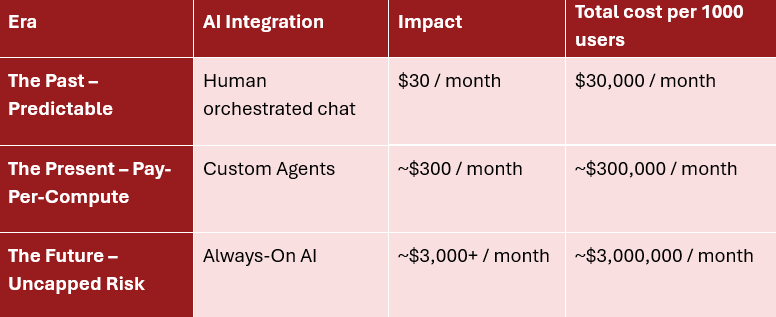
The Wall Street Journal recently reported that enterprises are hitting their annual AI budgets in just three months due to skyrocketing token costs. Bloomberg notes that giants like Walmart are already being forced to ration employee token usage to stop the bleed, while research from SemiAnalysis shows that a standard $300 AI subscription can easily mask up to $14,000 in underlying compute costs for heavy users.
Managing the Meter: Three Strategies for Success
So, how do you handle this new metered reality without blowing up your quarterly budget? It starts with shifting away from a static software procurement mindset and embracing real-time operational monitoring. A winning enterprise playbook needs to focus on three simple strategies.
- Teach proper context hygiene and prompt discipline to ensure your teams stop dumping massive, unnecessary SharePoint folders into a prompt when a targeted file would do.
- Adopt multi-model tiering by matching the tool to the task. Any simple, everyday administrative emails or basic data filtering should be routed to hyper-efficient, low-cost models like Gemini Flash or localized models. This saves expensive, heavyweight Microsoft or OpenAI reasoning tools only for high-stakes strategic analysis.
- Implement token and credit observability tools to trace spend back to specific departments so you can spot runaway costs before they show up on the company invoice.
If your organization treats enterprise AI like a traditional software license, where you buy a seat and just walk away, you are setting yourself up for a budgeting disaster. The tech giants have stopped absorbing the costs of heavy computing, and they are handing the bill directly to your department.
Navigating the Metering Shift with Arcurve
Figuring out how to pivot from predictable software licenses to highly volatile, metered infrastructure costs is a tough challenge, and you shouldn't have to tackle it alone. Arcurve offers an easy playbook to help you solve this today and future-proof your business. We specialize in pragmatic, high-impact technical solutions, from design through deployment and operationalization, to turn unpredictable cloud hurdles into steady, predictable business wins. We help you take control of your spending across three critical areas:
- Token Observability: we build automated frameworks to track exactly which teams and workflows are burning AI spend, before the bill arrives.
- Microsoft 365 Copilot Auditing: we surface hidden waste and cost exposure in your existing Copilot environment.
- Azure & Copilot Studio Guardrails: we design bulletproof controls so runawayagents and careless usage can't quietly drain your margins.
Don’t wait for an eye-watering vendor bill to realize you have a massive operational blind spot. Arcurve can protect your margins while keeping your operational velocity at full speed. Contact us today to gain control of your AI consumption and get back to driving measurable business outcomes.
Sources & Further Reading
- Microsoft Copilot Studio Operations & Billing Rates: Microsoft Learn: Copilot Credit Rates and Management Guide
- Microsoft Azure Capacity Billing Gateway: Microsoft Azure: Copilot Studio Pay-as-you-go Details
- Enterprise AI Token Economics: Virtasant Analysis: FinOps for AI and Token-Level Visibility
- The Macro Data Dataset: FinOps Foundation: State of FinOps 2026 Report Portal
- Microsoft Copilot Enterprise Pack Structures: Microsoft Business Portal: Microsoft 365 Copilot Agent Extensibility Pricing Options
- GitHub Copilot's Historical Move: GitHubBlog: GitHub Copilot is moving to usage-based billing
- Developer Cost Impact Perspectives: Visual Studio Magazine: Devs Sound Off on Usage-Based Copilot Pricing Change
- Compute Infrastructure Pressures Explained: Where's Your Ed At: Microsoft Moving All GitHub Copilot Subscribers To Token-Based Billing In June
- Analysis of Underlying Compute Cost vs Subscription: 'The math doesn't work': Why your $200 AI subscription is secretly worth thousands


