

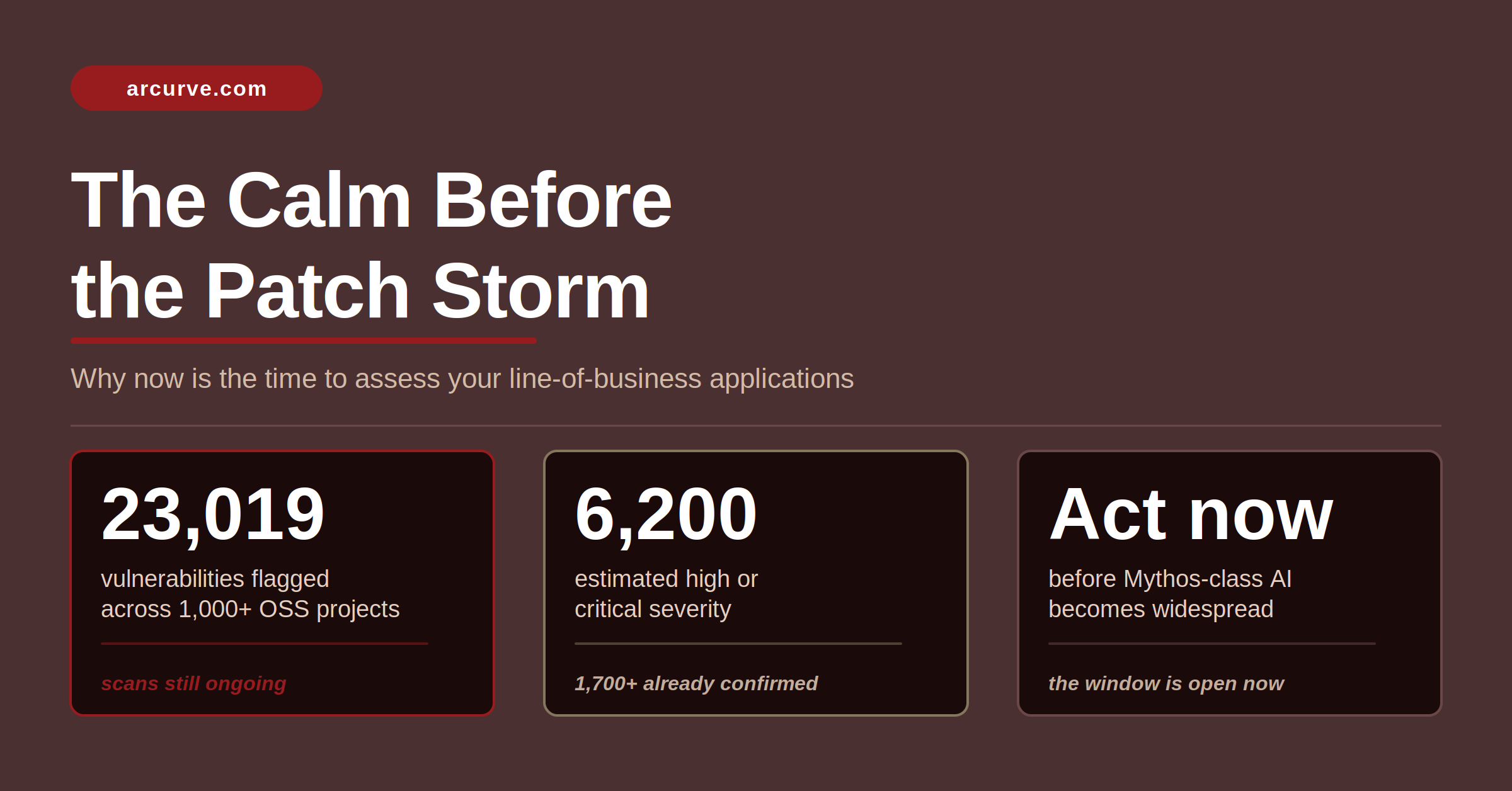
The Calm Before the Patch Storm: Why Now Is The Time to Assess Your Line-of-Business Applications
For years, security teams have operated under a familiar rhythm: a steady cadence of vulnerability disclosures, patches, and prioritization. That rhythm is about to be disrupted - fundamentally and permanently.
In April 2026, Anthropic revealed that its unreleased frontier AI model, Claude Mythos, had identified thousands of previously unknown, high‑severity software vulnerabilities, many of which had survived decades of human review. The discovery was so consequential that Anthropic made the unusual decision not to release Mythos to the public, restricting its use to a tightly controlled coalition of partners under an initiative called ProjectGlasswing, a defensive effort to identify and patch vulnerabilities before these capabilities proliferate.
This decision alone should give every CIO, CTO, and CISO pause.
Mythos Changes the Rules and the Timing
Claude Mythos is not just faster at finding bugs. It represents a step‑change in scale and depth. In controlled testing, the model discovered thousands of vulnerabilities in well‑maintained, trusted codebases that include operating systems, web browsers, and cryptographic libraries; even unearthing an OpenBSD flaw more than 25 years old.
Anthropic’s concern is not hypothetical. By their own assessment, releasing Mythos broadly today would meaningfully increase the risk of mass exploitation before defenders have time to react.
But here’s the reality for most enterprises:
You are not exclusively running operating systems and applications that receive high-frequency vendor-supported patches. You are running custom, in‑house, and deeply integrated line‑of‑business applications that almost certainly rely on open-source software maintained by the community, many of which are volunteers.
And those are precisely the systems most at risk.
Patchapalooza Is Coming and Custom Software Is the Hard Part
Canadian business leaders have already been warned. The Globe and Mail and other outlets recently described the looming surge in vendor patches triggered by Mythos‑powered discovery as a potential “patchapalooza”. A wave of updates that will strain testing capacity, change‑management processes, and operational resilience across industries.
For commercial off‑the‑shelf products, painful as this may be, there is at least a vendor roadmap.
For custom and in‑house applications, there often isn’t.
Many organizations are still running:
· Line‑of‑business systems written years ago by teams that no longer exist
· Applications built on outdated frameworks that no longer receive security updates
· Codebases that were “secure enough” under human‑paced discovery, but were never designed for machine‑paced vulnerability hunting
These applications are often invisible to automated inventory and assessment tools, and they are often mission‑critical. They cannot simply be patched automatically.
This Is Where Arcurve Comes In
Arcurve specializes in precisely this problem space: complex, business‑critical applications developed in‑house or extended through custom software.
Our approach starts with reality, not assumptions, and it is grounded in a proven practice that we have refined over hundreds of engagements.
We have a deep track record in technical due diligence, including multiple engagements for private equity firms evaluating acquisitions valued into the $100M range, where we assess architecture, security posture, vulnerabilities, and third-party dependencies, and deliver clear, prioritized go-forward recommendations.
That same methodology, applied now through the lens of Mythos-era risk, is how we help clients move from anxiety to action.
1. Assess and Triage What You Actually Have
Arcurve works with clients to inventory and assess line-of-business applications in context:
- What does the application do?
- What is it built on?
- How exposed is it?
- What is the business impact if it fails or is compromised?
This is not vulnerability scanning in isolation. It is risk-in-context.
2. Make Deliberate, Informed Decisions
Not every vulnerability warrants the same response. Arcurve helps clients develop a go-forward plan that may include:
- Do nothing (where risk is low or well-mitigated)
- Remediate in place
- Harden and contain
- Retire
- Re-write or modernize
- Transition to an alternate platform or service
The right answer is not always "patch immediately." Sometimes the right answer is "stop investing in the wrong thing."
3. Execute - Safely and Intelligently
Knowing what to do is only half the battle. Arcurve has the capability and experience to execute remediation, modernization, or transition plans without disrupting the business, even in environments with tight regulatory or operational constraints.
Why Now Matters
Anthropic has been explicit: Mythos‑class capabilities will not remain exclusive for long. The current window exists only because access is restricted, not because discovery has slowed.
When these techniques become more widely available, whether through competitors, diffusion, or imitation, the backlog of undiscovered vulnerabilities in custom enterprise software will surface quickly.
Organizations that wait will be forced into reactive decisions under pressure.
Organizations that act now can choose deliberately.
A Call to Action
If your organization relies on in‑house or heavily customized line‑of‑business applications, this is the moment to evaluate them – before AI‑driven discovery evaluates them for you.
Arcurve can help you understand:
- What matters
- What's at risk
- And what, realistically, you should do next
The patch storm is forming.
Smart organizations prepare before it breaks.


